


Workplace Near Miss
Introduction
The following is a practical guide to managing workplace near misses in line with Queensland’s Work Health and Safety Act 2011 (Qld), Work Health and Safety Regulation 2011 (Qld), applicable Queensland Codes of Practice, Workplace Health and Safety Queensland and other relevant Queensland Government sources. It aims to provide clear and concise instructions that can be implemented immediately. For clarity, the information is presented in a step-by-step format (Queensland Government, 2011a; Queensland Government, 2011b).
Near misses are events that have the potential to cause harm but do not result in injury or damage. Effective management of near misses is crucial for preventing more serious incidents and accidents. By addressing near misses early, a PCBU can identify and correct hazards before they result in injuries or other consequences.



Protect People and Preserve the Site
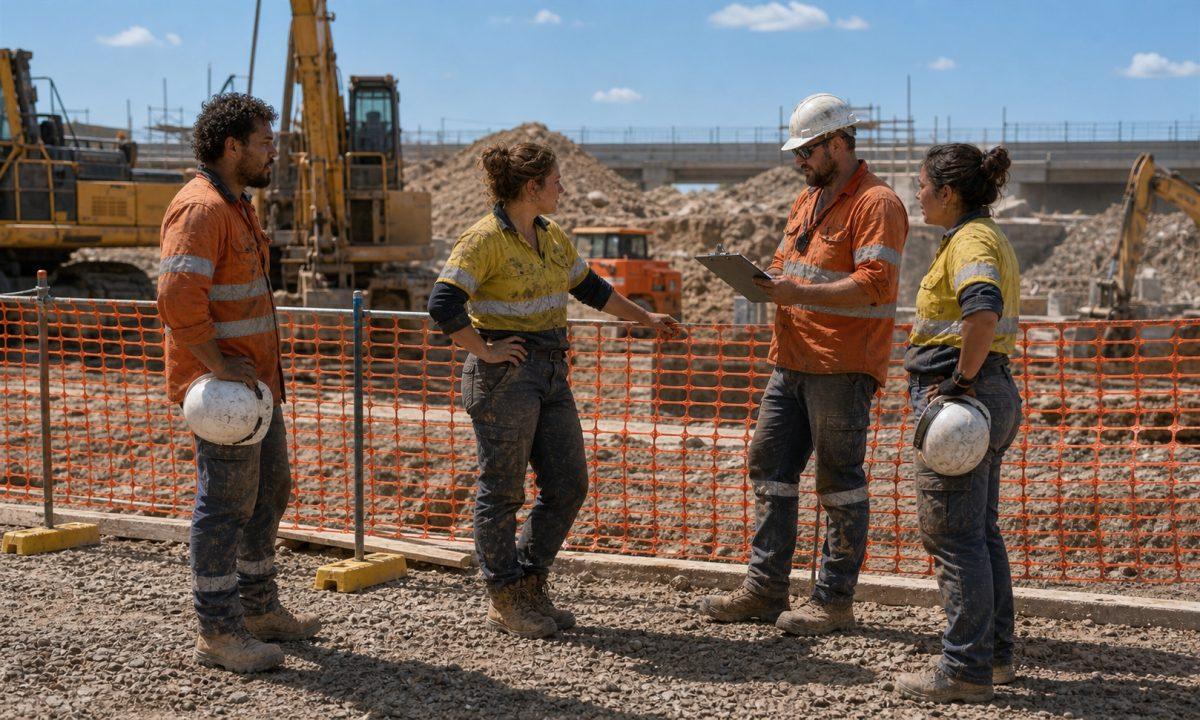
After a near miss occurs, it is essential to take immediate steps to protect workers. Their safety should be the first priority. Take appropriate measures to prevent further harm and allow those involved to receive medical attention if necessary. Work may need to stop until it is clear that there are no ongoing risks. The area should also be secured so that relevant information and evidence are not lost before the incident is assessed.
The statutory duty to preserve a site applies when the event is a notifiable incident.
Section 39 of the Work Health and Safety Act 2011 (Qld) requires the person with management or control of the workplace to preserve the site, so far as is reasonably practicable, until an inspector arrives or gives an earlier direction. The site may still be disturbed to assist an injured person, remove a deceased person, make the site safe, minimise the risk of another notifiable incident, support a police investigation or act with permission from an inspector or the regulator. For a near miss that is not notifiable, securing the area and preserving evidence remain useful investigation practices rather than a statutory site-preservation duty (Queensland Government, 2011a).
Check Whether the Incident Is Notifiable
A near miss is not automatically a notifiable incident, but it may be notifiable even when nobody is injured. Under section 35 of the Work Health and Safety Act 2011 (Qld), a notifiable incident is the death of a person, a serious injury or illness, or a dangerous incident. Section 37 defines a dangerous incident as an event that exposes a worker or another person to a serious risk arising from immediate or imminent exposure to specified hazards or events (Queensland Government, 2011a; Workplace Health and Safety Queensland, n.d.).
If the incident is notifiable, the PCBU must notify the regulator immediately after becoming aware of it and use the fastest possible means. Notification may be given by telephone or in writing. If notice is given by telephone, the regulator may require written notice within 48 hours of that request. The assessment should therefore consider what occurred and the serious risk created, rather than only whether an injury or damage resulted (Queensland Government, 2011a).
The three categories of notifiable incident
Death of a person
- the death of any person is always a notifiable incident
Serious injury or illness
- immediate treatment as an in-patient in a hospital
- immediate treatment for the amputation of any part of the body
- immediate treatment for a serious head injury
- immediate treatment for a serious eye injury
- immediate treatment for a serious burn
- immediate treatment for the separation of skin from underlying tissue, such as degloving or scalping
- immediate treatment for a spinal injury
- immediate treatment for the loss of a bodily function
- immediate treatment for serious lacerations
- medical treatment within 48 hours of exposure to a substance
Dangerous incident
- an uncontrolled escape, spillage or leakage of a substance
- an uncontrolled implosion, explosion or fire
- an uncontrolled escape of gas or steam
- an uncontrolled escape of a pressurised substance
- electric shock
- the fall or release from a height of any plant, substance or thing
- the collapse, overturning, failure or malfunction of, or damage to, any plant required to be authorised for use under a regulation
- the collapse or partial collapse of a structure
- the collapse or failure of an excavation or of any shoring supporting an excavation
- the inrush of water, mud or gas in workings, in an underground excavation or tunnel
- the interruption of the main system of ventilation in an underground excavation or tunnel
Record What Happened
A thorough record of the incident should be made as soon as possible. The record should include the following:
1. What happened
A plain account of the event and its outcome, describing the sequence of actions that occurred and keeping observations separate from assumptions about the cause.
2. When and where it happened
The time of the incident and its exact location, described in enough detail that another person reading the record can identify the spot, along with the conditions at the time.
3. Who was involved or witnessed the incident
The people directly and indirectly involved and any eyewitnesses, with contact details captured early, because witness recollection fades the longer it is left.
4. The work being performed
The task and the system of work being carried out at the time, including how the work was actually done compared with how it is normally done, and the tools and equipment in use.
5. The controls in place
The control measures relied on to prevent the event, including any protective equipment or devices, and whether they were working as intended.
6. Any physical evidence that exists
Physical items linked to the incident, such as plant, equipment, debris and equipment settings, secured and photographed before the scene is disturbed.
Photographs, video, equipment information and relevant documents may also assist. Gathering this information promptly helps preserve details while they are fresh in people’s minds.
The record should separate observations from assumptions. It should also identify any immediate action taken, including work stoppages, temporary controls, notification decisions and changes made to the site. This information will support the investigation and the corrective actions that follow.
What Allowed the Incident to Occur?
The next step is to determine what allowed the near miss to occur. The cause can often be traced to organisational systems or work practices rather than a single individual error. Planning, equipment, supervision, maintenance, training, workload and the work environment may all have influenced the event (Dekker, 2014; Reason, 1997).
A useful investigation looks beyond the final action and examines the conditions that made it possible. Workers and health and safety representatives can provide practical information about how the task is normally performed and whether the documented procedure reflects the work. Identifying these issues allows the organisation to address the cause of the near miss rather than only its immediate outcome.
Review the Safety Measures
The controls that were expected to prevent the event should be reviewed. Section 38 of the Work Health and Safety Regulation 2011 (Qld) requires control measures to be reviewed and revised when necessary. A review is required:
1. The control is not effective
The measure does not control the risk it was implemented to control, so far as is reasonably practicable. This is shown where monitoring indicates the control is not working, or where a notifiable incident occurs because of the risk.
2. A change at the workplace is coming
A review is required before a change that is likely to give rise to a new or different risk the measure may not effectively control. A change includes a change to the workplace or the work environment, or to a system of work, a process or a procedure.
3. A new hazard or risk is identified
A new relevant hazard or risk emerges that the existing controls were not implemented to address.
4. Consultation indicates a review is necessary
The results of consultation by the duty holder under the Act or the Regulation indicate that a review of the control measure is necessary.
5. A health and safety representative requests a review
A health and safety representative may request a review where they reasonably believe one of the above circumstances affects the health and safety of a member of their work group and the duty holder has not adequately reviewed the control in response. (Queensland Government, 2011b).
The PCBU should consider whether existing procedures, training and equipment are adequate and whether the hazard can be eliminated. If elimination is not reasonably practicable, more effective controls may be required. Any revised control should be suitable for the work as it is actually performed and should not introduce a new risk (Workplace Health and Safety Queensland, 2021).
Assign and Verify Corrective Actions
Once corrective actions have been determined, responsibility for each action should be assigned to a person who has the authority and resources to complete it. Clear time frames should be established so that the response does not stop at the investigation report. Interim controls may be needed while a permanent change is being completed.
The PCBU should verify that each action has been implemented and that it controls the identified risk in practice. If the action is ineffective or creates another problem, it should be revised. Closing an action should mean that the change has been checked at the workplace, not simply that a task has been marked complete.
Information for Officers
Near-miss information can show whether the organisation’s safety systems are identifying hazards and responding to risk. Section 27 of the Work Health and Safety Act 2011 (Qld) requires officers to exercise due diligence to ensure that the PCBU complies with its duties and obligations (Queensland Government, 2011a).
Officers should ensure that the PCBU has suitable resources and processes for receiving, considering and responding promptly to information about incidents, hazards and risks. They should also ensure that processes exist for complying with WHS duties and verify that those resources and processes are being used. Near-miss reporting should therefore provide enough information for officers to understand significant and recurring risks, the response taken and whether corrective actions have been verified.
Keep the Required Records
Section 38 of the Work Health and Safety Act 2011 (Qld) requires a PCBU to retain a record of each notifiable incident for at least five years from the date on which notice is given to the regulator. This statutory period applies to notifiable-incident records. The Act does not impose a general two-year retention period on every near-miss record (Queensland Government, 2011a).
Records of other near misses should still be kept as part of the organisation’s incident-management system. They can include the original report, evidence gathered, notification assessment, investigation findings, consultation, corrective actions and verification. The retention period for those records should be determined by the organisation’s legal and operational requirements.
Conclusion
Proactive management of near misses helps prevent more serious incidents. The immediate response should protect people, determine whether notification and site-preservation duties apply, and preserve reliable information about what occurred. The investigation can then identify what allowed the event to happen and whether existing controls remain effective.
The response is complete only when corrective actions have been implemented and verified. A near miss that is not legally notifiable still provides an opportunity to identify weaknesses and improve the way risks are managed before somebody is harmed.
References
Dekker, S. (2014). The field guide to understanding “human error” (3rd ed.). Ashgate.
Queensland Government. (2011a). Work Health and Safety Act 2011 (Qld). Queensland Legislation. https://www.legislation.qld.gov.au/view/html/inforce/current/act-2011-018
Queensland Government. (2011b). Work Health and Safety Regulation 2011 (Qld). Queensland Legislation. https://www.legislation.qld.gov.au/view/html/inforce/current/sl-2011-0240
Reason, J. (1997). Managing the risks of organisational accidents. Ashgate.
Workplace Health and Safety Queensland. (2021). How to manage work health and safety risks Code of Practice 2021. Queensland Government. https://www.worksafe.qld.gov.au/__data/assets/pdf_file/0022/72634/how-to-manage-work-health-and-safety-risks-cop-2021.pdf
Workplace Health and Safety Queensland. (n.d.). Confirm if an incident is notifiable. Queensland Government. Retrieved 8 August 2026, from https://www.worksafe.qld.gov.au/safety-and-prevention/incidents-and-notifications/notify-us-of-an-incident/notify-workplace-health-and-safety-queensland-or-electrical-safety-office/confirm-if-an-incident-is-notifiable


